
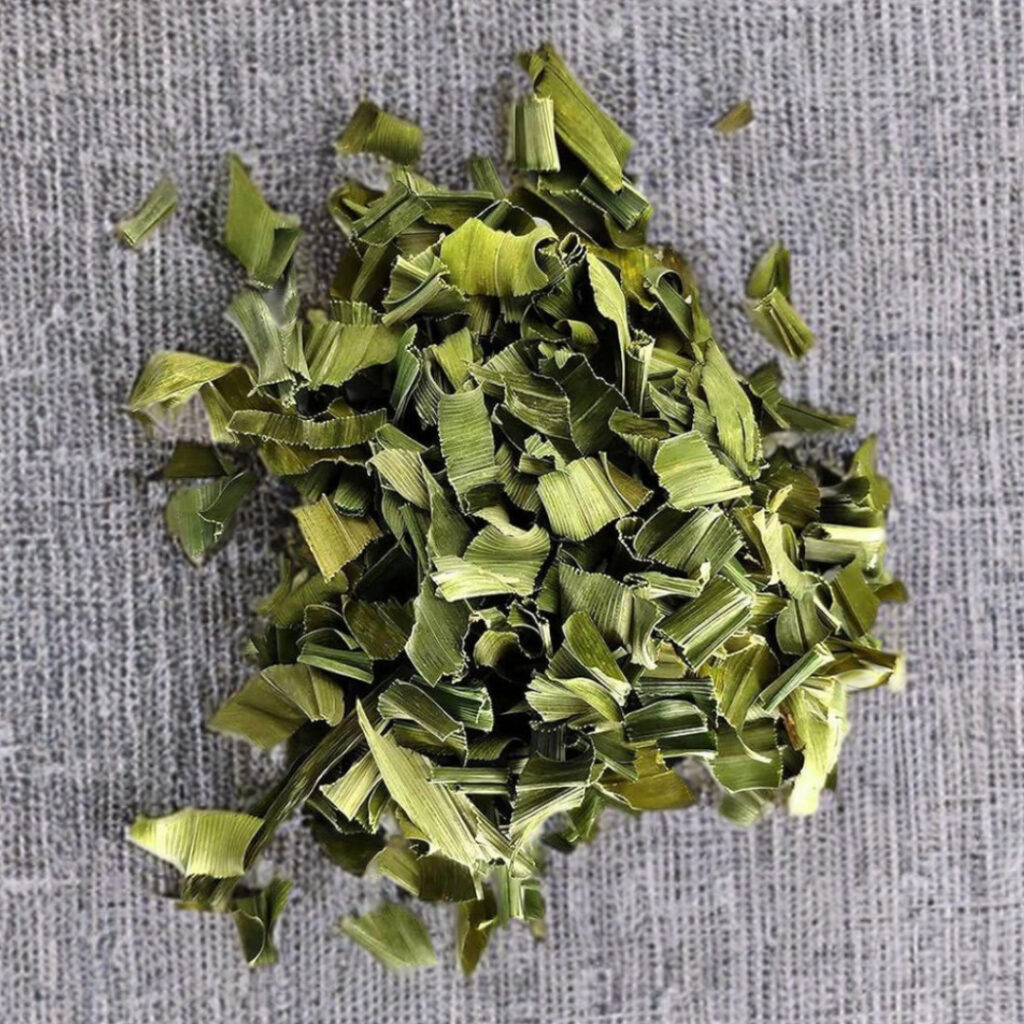
Ask ten people what pandan tastes like and you will get vanilla, coconut, freshly cut grass, jasmine rice, and — from at least one — bubblegum. None of them are wrong, which is exactly why the question keeps getting asked. Here is a more useful answer.
The short version
Pandan tastes sweet, grassy and faintly nutty, with an aroma closer to vanilla than to any herb you probably know. It is gentler than mint, rounder than lemongrass, and it has none of the sharpness of citrus or ginger. If you have eaten good jasmine rice and noticed a warm, almost milky smell coming off it, you are close: pandan and jasmine rice share an aroma compound, which is why Thai and Malaysian cooks drop a knotted leaf into the rice pot.
Why people say “vanilla”
The comparison is not lazy. The dominant aroma compound in pandan is 2-acetyl-1-pyrroline, the same molecule that gives basmati and jasmine rice their scent and that turns up in fresh white bread. Your nose files it under “warm, sweet, baked”, and vanilla is the nearest thing most kitchens have to that.
But pandan is not a vanilla substitute. Vanilla is rich and slightly boozy. Pandan is green underneath the sweetness — there is always a fresh, leafy note running beneath it, the way there is in green tea. Use it expecting vanilla and it will taste oddly herbal. Use it expecting a sweet green leaf and it makes sense immediately.
What it tastes like brewed as tea
Brewed on its own, dried pandan makes a pale gold cup that is:
- Mildly sweet without any sugar — the sweetness is aromatic rather than actual, the same trick a vanilla pod plays.
- Soft and rounded, with no astringency or bitterness even if you forget it on the counter for twenty minutes.
- Nutty on the finish, a little like the water left after cooking good rice.
- Strongly scented — you will smell it across the room before you taste it.
It is one of the least challenging teas we sell. If someone finds most herbal infusions either too sour or too medicinal-tasting, pandan is usually the one that wins them over.
What pandan is not
It is not minty, citrusy, floral or spicy. It is not related to bamboo, lemongrass or matcha, though it gets compared to all three because of the colour. And the bright green pandan cake and kaya jam you may have seen owe most of that colour to added colouring, not to the leaf — brewed pandan is closer to pale straw.
It is also not a flower. Pandan is the long, blade-like leaf of Pandanus amaryllifolius, which is why we sell it as pandan leaf tea rather than pandan flower tea.
What it goes with
Pandan is a natural partner for anything sharp or citrusy, because it rounds off edges. In Thailand it is most often paired with lemongrass, which is why we sell the two together as a lemongrass and pandan blend — the lemongrass brings the lift, the pandan brings the sweetness underneath it.
It also takes very well to coconut milk, to a squeeze of lime, and to ice.
Try it before you commit
Because pandan divides people, we sell it from a 20g pack — enough for roughly eight cups. If the vanilla-grass thing is not for you, you have not lost much. If it is, it keeps well for months in a sealed jar.