
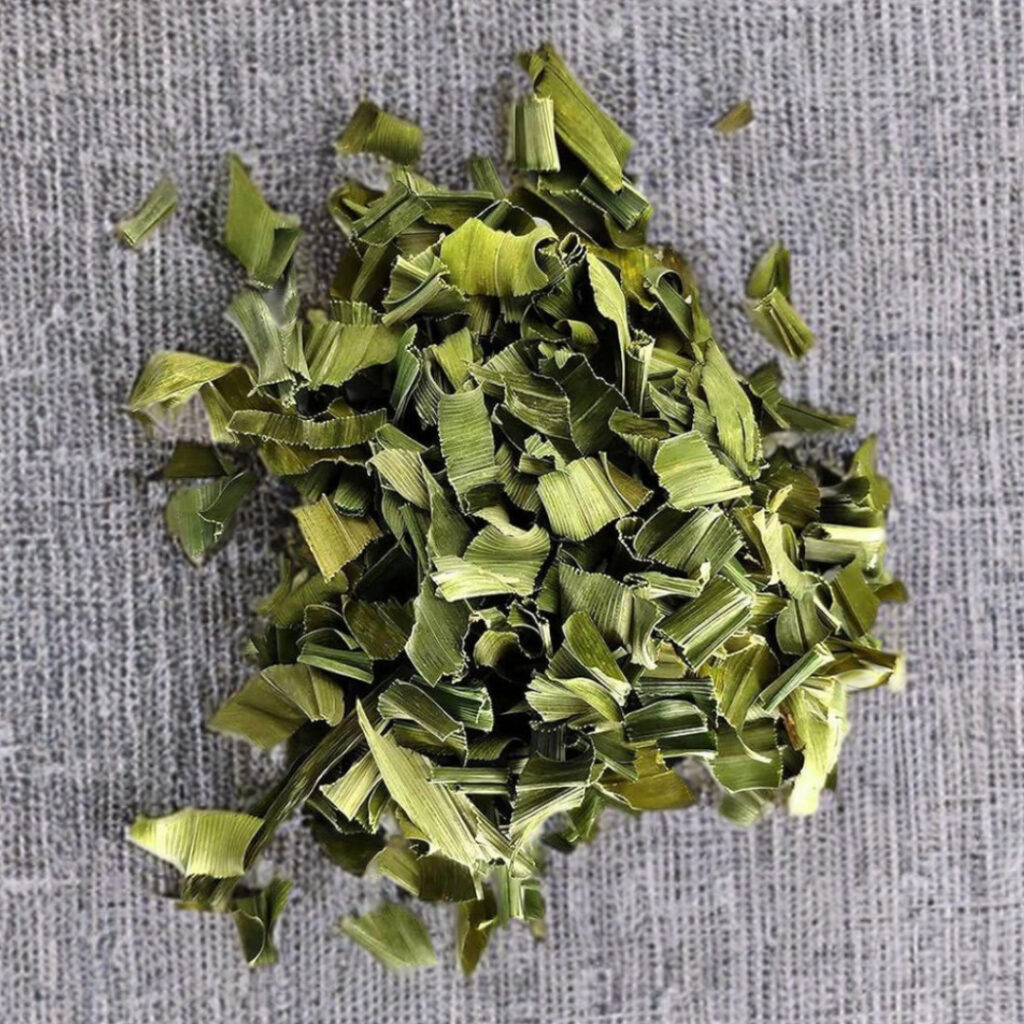
Almost every pandan recipe online assumes you have fresh leaves and tells you to simmer them. If you have bought dried pandan, that advice is only half right. Here is what actually works, with real quantities.
The short answer
Steep it. Dried pandan has already had its cell walls broken down by drying, so a hot steep pulls the aroma out perfectly well. Simmering is for fresh leaves, which are waxy and need more persuasion — and boiling dried pandan hard for ten minutes mostly drives the aroma into your kitchen instead of your cup.
Hot, by the numbers
- Quantity: 2–3g per cup (250ml). That is roughly 1–2 teaspoons of cut leaf — pandan is light and fluffy, so it looks like more than it weighs.
- Water: just off the boil, 90–100°C. There is no delicate compound here to scorch.
- Time: 5–8 minutes, covered. Covering matters more with pandan than with almost anything else we sell, because the aroma is volatile — an uncovered pot loses most of what you are paying for.
- Strain: a fine mesh catches the small pieces. A mesh strainer is easier than a bag, because the leaf needs room to move.
Leave it longer and it does not turn bitter — pandan has almost no tannin. A fifteen-minute steep simply tastes stronger and slightly more savoury.
When simmering is right
Simmer when you want a concentrate rather than a cup: for a jug of iced tea, for a syrup, or when you are cooking with it. Use about 10g to 500ml, bring it barely to a boil, then drop to a bare simmer for 8–10 minutes with a lid on. You will get a deeper, more golden liquid that stands up to ice and dilution.
Do not boil it uncovered and do not walk away. The point of the lid is to condense the aroma back into the pot.
Iced pandan
This is how it is most often drunk in Thailand. Brew it at double strength — 5g per 250ml — sweeten while it is still hot if you are going to, then chill and pour over plenty of ice. Sweetening cold does not work well; sugar will not dissolve.
A squeeze of lime at the end turns it into something much closer to a soft drink than a tea.
Cold brew
Pandan cold-brews beautifully and is very forgiving. Use 5g per 500ml of cold water, leave it in the fridge overnight (8–12 hours), and strain. The result is cleaner and sweeter than a hot brew, with the grassy note pushed back.
Can you re-steep it?
Once, usefully. A second steep of the same leaf gives a noticeably lighter cup — pleasant, but thin. A third is water with a memory. If you want two strong cups, use more leaf rather than trying to stretch it.
Storing it
Airtight, away from light and heat, and away from anything strongly scented — dried pandan will take on the smell of a spice cupboard within weeks. Kept properly it holds its aroma for the better part of a year. If you open the jar and cannot smell it from arm’s length, it has gone flat.