
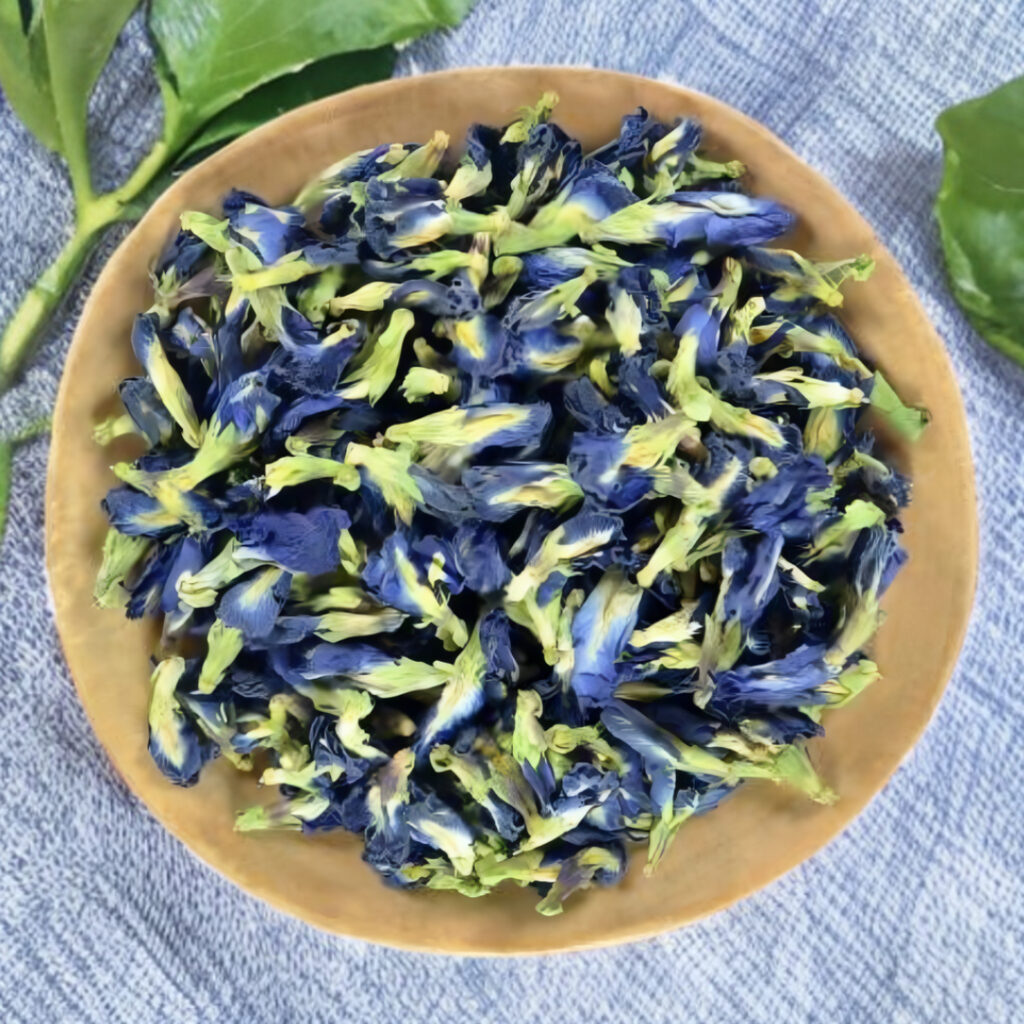
Butterfly pea is the flower behind every photograph of a drink that starts blue and turns purple as lime hits it. In Thailand it is dok anchan (ดอกอัญชัน), and it has been used as a food colouring far longer than it has been a social-media trick.
Why the colour changes
The blue comes from anthocyanins — the same family of pigments that make blackcurrants dark and red cabbage red. Anthocyanins are sensitive to acidity, and they shift colour depending on the pH of what they are sitting in.
Plain water is roughly neutral, so the infusion stays a deep indigo blue. Add something acidic — lime, lemon, tamarind — and the pigment shifts toward violet, then pink-magenta as you add more. Add something alkaline and it moves the other way, toward green.
It is a genuine chemical indicator, not a dye trick. The colour will keep responding every time you change the acidity of the glass.
How to brew it
Butterfly pea is a flower, not a leaf, and it gives up its colour quickly. It is one of the hardest infusions to over-brew.
- Use 8–10 dried flowers per 250ml, or a generous pinch.
- Water just off the boil.
- Steep 3–5 minutes. The colour arrives well before the flavour does — do not judge by sight and pull it early.
- Strain out the flowers.
Leaving the flowers in longer deepens the blue toward near-black without adding bitterness. There are no tannins here to turn harsh, which is why it is such a forgiving thing to brew.
The colour-change lemonade
This is the version worth making, and it only works if you build it in the right order.
- Brew the butterfly pea strong — roughly double the flowers — and let it cool completely.
- Fill a tall glass with ice.
- Pour the cold blue infusion over the ice.
- Serve the lime wedge on the side, and let whoever is drinking it squeeze it in.
The change happens in front of them, in seconds, spreading from where the juice lands. Mix the lime in beforehand and you just have a purple drink.
What it actually tastes like
Honestly? Very little. Butterfly pea is extremely mild — faintly green, faintly woody, closer to a very light steamed vegetable than to tea. People expecting a flavour to match the colour are usually surprised by how quiet it is.
That mildness is exactly why it works as a base. It carries lime, lemongrass, honey or ginger without arguing with any of them, and it colours anything you put it in. Treat it as a colour and a canvas rather than a flavour in its own right.
Using it as a natural colouring
This is its traditional Thai role. A strong infusion is used to tint rice, sweets and jellies a blue that is difficult to get from anything else natural. Because the flavour is so faint, it colours without changing how the dish tastes — and because it is pH-sensitive, adding a sour element to the same dish will shift it toward purple.